

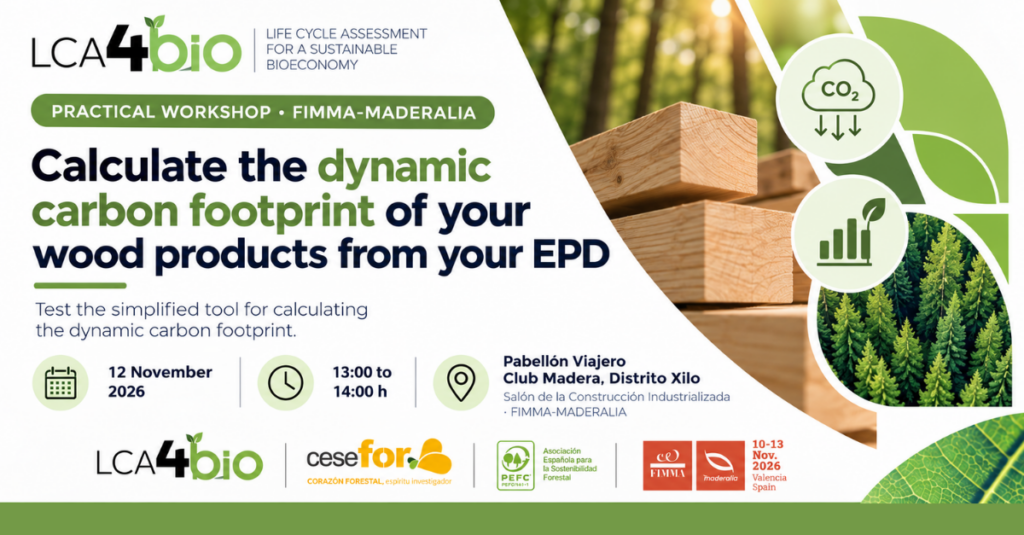
The workshop will take place on 12 November 2026 at 13:00 at the Pabellón Viajero Club Madera, located in Distrito Xilo, within the Industrialised Construction Hall at FIMMA-MADERALIA.
The workshop is organised within the framework of the European LCA4BIO project, which works to develop and harmonise reliable Life Cycle Assessment (LCA) methodologies for bio-based products with a high level of technological maturity.
One of the project’s outputs is a draft normative module, which was open for public consultation until 1 November 2026 and includes this tool. The aim of the workshop is to validate the tool with companies from the sector.
Why is this relevant?
The new Construction Products Regulation progressively introduces mandatory environmental sustainability declarations for construction products, based on indicators from the UNE-EN 15804 standard obtained through Life Cycle Assessment (LCA). However, this standard has limitations when applied to wood products, as the effect of CO₂ capture can be diluted in the calculation of climate change impacts.
What does the tool offer for wood products?
Wood captures carbon dioxide as trees grow and keeps it stored throughout the product’s service life. The static calculation used in Environmental Product Declarations (EPDs) under UNE-EN 15804 accounts for carbon capture and emissions as if they occurred simultaneously and reports results over a 100-year time horizon. As a result, the duration of carbon storage is not reflected in the results, potentially putting wood products at a disadvantage.
The LCA4BIO tool follows a hybrid static-dynamic approach that enables emissions and CO₂ capture to be assessed more accurately by taking into account when these processes occur over time.
The tool is available as a simple web application that only requires data from your EPD. It also allows you to compare the results with those obtained using the static method (UNE-EN 15804) and RE2020, the French regulation for the construction of new buildings.
What can you expect from the workshop?
Bring the EPD for your wood product! During the session, accompanied by refreshments, we will demonstrate how to use the tool and calculate your product’s carbon footprint using the dynamic approach. We will then compare the results with those obtained under UNE-EN 15804 and RE2020.
You will have the opportunity to share your feedback and discuss the results with other companies in the sector, as well as learn more about the LCA4BIO project.
Your contributions, together with the feedback gathered through the public consultation, will help us assess the tool’s applicability to the wood sector and improve the normative module describing its methodology.
Interested in taking part?
Register here: https://share-eu1.hsforms.com/1vpc8iK9nQFqkO_ZCpfO1pA2e02l8
